FlowPilot Can Save Your VFX Studio $40K A Year
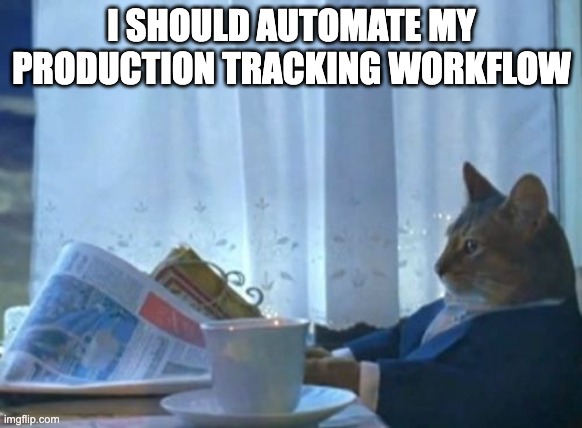
I'll let you in on a secret: every developer at your studio hates it when a
stakeholder says:
"It should be an easy fix"
They might answer with "sure, when do you need it by?" but are really
thinking "if it's easy, why don't you do it yourself".
Well? Guess what. We've been cooking here at FlowPilot.studio, and you can now just
ask our Claude Haiku / Sonnet 4.5 assistants to
build your dashboards and automations; and you can free up your dev resources to
work on more complex tasks. More arduous stuff. It turns out solving Production
Tracking was doable.
Why? Because it's mostly the same know-how, show after show. We've been doing this for
decades, decided to automate our jobs and put it all at your fingertips; just a single
prompt away.
The Hidden Cost of "Just Build It In-House"
What should have been a simple matter of writing a handful of Python scripts to pull data from Flow PT and display it nicely turns out to be more work than initially expected. Does this sound familiar?
Well consider this typical scenario: a content platform like Netflix or Amazon commissions some VFX work. The post-production team is assembled for a 6-to-18-month engagement. Some of your demanding, precise and meticulous producers want dashboards, status reports, shot tracking views, and automated status updates, all wired into their ad-hoc Flow PT setup.
A dev ends up spending weeks setting this up. Then the show wraps, the team disperses, and the next show starts from scratch with staff rotations and fresh requirements. The setup cost isn't a one-off: it's a recurring expense baked into every single show.
Here's where studios typically spend money on manual Flow PT integration:
- Development setup: building custom dashboards, reports, and data pipelines for each new show. Requirements gathering, development, testing, stakeholder review.
- Coordination overhead: technical staff fielding data requests from producers, troubleshooting broken reports, attending status meetings to explain numbers that should be self-serve.
- Infrastructure: cloud hosting, databases, monitoring, and CI/CD pipelines for custom solutions.
And the worst part? It's a cycle. Every show goes through the same loop:
What If You Don't Have Developers?
Not every studio has pipeline developers. In many small and mid-sized studios, there's a TD and a handful of coordinators. There's no budget for custom automation, so coordinators switch statuses manually, export CSVs into spreadsheets, copy numbers into email reports, and sit in meetings to walk producers through data that should be self-serve.
The costs here are hidden. No one's writing a cheque for "manual Flow PT work," but coordinators are spending hours a week on repetitive data entry instead of actual coordination. Artists lose time when statuses are wrong or late. Producers chase updates that should update themselves. It adds up fast, and it's prone to error.
In the calculator below, set "Developers" to zero and add however many coordinators spend time on this, with their monthly cost. Set infrastructure to zero. You'll see the real cost of "no budget for automation."
Calculate Your Studio's Numbers
Adjust the sliders to match your studio: region, show volume, team composition, and monthly costs. The cost breakdown updates live as you drag.
What Does This Add Up To?
Based on your inputs, the cost of manual Flow PT work over 12 active months comes to $50,400. Compared to a FlowPilot Insights Pro + Automations Pro subscription at $623/month for the same period, that's a potential saving of:
How We Calculated This
We based these numbers on real-world data from studios we've worked with, combined with industry-standard rates by region. Here's the model:
Active months is however many months per year you have at least one show running: projects per year × average duration, capped at 12. If you run 2 shows of 3 months each, that's 6 active months. Both the manual cost and the FlowPilot subscription are calculated over this period only.
People cost is split into two roles: Developers (who build and maintain custom integrations) and Coordinators (who handle manual data entry, status updates, and reporting). For each role, you set the number of people and the monthly cost attributable to Flow PT work. This isn't their full salary; it's the portion of their time spent on automation, dashboards, and data wrangling, expressed as a monthly figure.
Infrastructure cost covers hosting for event daemons, webhook servers, or any cloud services running your custom Flow PT integrations. Studios without custom tooling can set this to zero.
The default monthly costs represent the portion of each role's salary attributable to Flow PT work, not their full compensation. For Developers, $3,000/month corresponds roughly to 15-20% of a senior developer's or TD's loaded cost. For Coordinators, $1,000/month covers the time spent on manual data entry and status updates. Many studios report significantly higher numbers, especially for senior pipeline TDs.
Industry Benchmarks
We researched 120 VFX studios across four regions to ground these numbers in reality. On average, a studio works on 11 shows over five years, roughly 2 per year.
US
Canada
UK
EU
Across all regions, the average estimated saving is $30k per year, using conservative assumptions (1 developer and 1 coordinator each spending ~20% of their time on Flow PT work, year-round projects).
What This Looks Like in Practice
To put these numbers in context, here's what a mid-sized VFX studio (80+ artists) could expect after switching to FlowPilot — based on the cost model above.
Before
- 2 developers spending 15% of their time on Flow PT integrations
- Custom Python scripts requiring constant maintenance
- Producers waiting days for data exports
- $800/month in AWS infrastructure costs
After
- Developers fully refocused on pipeline tools
- Producers building their own dashboards
- Real-time data access via live exports
- No infrastructure to maintain
We're Launching!
Want a Deeper Analysis?
Every studio's situation is different. If you'd like us to walk through the numbers for your specific setup, factoring in your team size, show mix, and existing infrastructure, we're happy to do a detailed cost analysis.